USGS

Isis 3.0 Developer's Reference (API)

Home

Isis::MaximumLikelihoodWFunctions Class Reference

Class provides maximum likelihood estimation functions for robust parameter estimation e.g. More...

#include <MaximumLikelihoodWFunctions.h>

List of all members.

Public Types

enum  Model { Huber, HuberModified, Welsch, Chen }
 

These are/supported maximum likelihood estimation models, each has an accompannying private method that converts from a resiuduals to a weight scaler.

More...

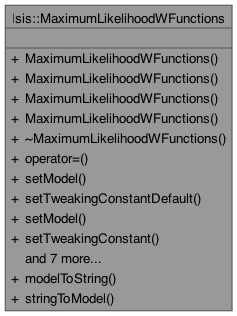
Public Member Functions

 MaximumLikelihoodWFunctions ()
 MaximumLikelihoodWFunctions (Model modelSelection, double tweakingConstant)
 Sets up a maximumlikelihood estimation function with specified model and tweaking constant.
 MaximumLikelihoodWFunctions (Model modelSelection)
 Sets up a maximumlikelihood estimation function with specified model and default tweaking constant.
 ~MaximumLikelihoodWFunctions ()
bool setModel (Model modelSelection, double tweakingConstant)
 Allows the maximum likelihood model to be changed together with the tweaking constant.
bool setModel (Model modelSelection)
 Allows the maximum likelihood model to be changed together and the default tweaking constant to be set.
bool setTweakingConstant (double tweakingConstant)
 Allows the tweaking constant to be changed without changing the maximum likelihood function.
bool setTweakingConstantDefault ()
 Sets defualt tweaking constants based on the maximum likelihood estimation model being used.
double sqrtWeightScaler (double residualZScore)
 This provides the scaler to the sqrt of the weight (which is very useful for building normal equations).
double tweakingConstantQuantile ()
 Suggest a quantile of the probility distribution of the residuals to use as the tweaking constants based on the maximum likelihood estimation model being used.
double tweakingConstant ()
 Returns the current tweaking constant.
void maximumLikelihoodModel (char *model)
void weightedResidualCutoff (char *cutoff)

Detailed Description

Class provides maximum likelihood estimation functions for robust parameter estimation e.g.

in bundle adjustment.

A maximum likelihood estimation W function provides a scheme for 're-weighting' observations so that measures with large residuals have reduced or negligible effect on the solution. There are many such functions available, a few have been programmed into this class. See enum Model documentation for specifics of the estimation models. References: Zhangs, "Parameter Estimation: A Tutorial with Application to Conic Fitting" Koch, "Parameter Estimation and Hypothesis Testing in Linear Systems" 2nd edition chapter 3.8 Manual of Photogrammetry 5th edition chapter 2.2 (particularly 2.2.6) Chen "Robust Regression with Projection Based M-estimators"

Author:
2012-03-23 Orrin Thomas

Member Enumeration Documentation

These are/supported maximum likelihood estimation models, each has an accompannying private method that converts from a resiuduals to a weight scaler.

Enumerator:
Huber 

According to Zhang (Parameter Estimation: A Tutorial with application to conic fitting) [Huber's] estimator is so satisfactory this is has been recommended for almost all situations; very rarely has it been found to be inferior to some other function.

Its one deficiency is the discontinuous second derivative which cause rare diffeculites. No measures are totally disregarded. http://research.microsoft.com/en-us/um/people/zhang/Papers/ZhangIVC-97-01.pdf

HuberModified 

A modification to Huber's method propsed by William J.J.

Rey in Introduction to Robust and Quasi-Robust Statistical Methods. Springer, Berlin, Heidelberg, 1983. It has similiar properties to the Huber, but with a continuous second derivative. This comes at the cost of being somewhat more computationally expernsive. No measures are totally disregarded. http://research.microsoft.com/en-us/um/people/zhang/Papers/ZhangIVC-97-01.pdf

Welsch 

The Welsch method aggresively discounts measures with large resiudals.

Residuals two times greater than the tweaking constant are all but ignored. This method can be risky to use (at least at first) because it does not gaurantee a unique solution. And if sufficient measures are effectively 'removed' by the weighting, the system can become singular. The manual of photogrammetry recommended using it for clean up after convergeance or near convergeance had been optained with a more stable method (such as Huber's). http://research.microsoft.com/en-us/um/people/zhang/Papers/ZhangIVC-97-01.pdf

Chen 

The Chen method was found in "Robust Regression with Projection Based M-estimators" Chen, et.

al., though Chen does not take credit as the author. It was of interest because he seemed to present its use as expected in systems with large numbers of outliers, and because of it's unique properties. It is exceptionally aggresive. Residuals less than the tweaking constant generally have MORE influence than in standard least squares (or any other estimation function I've studied), and residuals larger than the tweaking function are totaly discounted.


Constructor & Destructor Documentation

Isis::MaximumLikelihoodWFunctions::MaximumLikelihoodWFunctions (  )  [inline]

References Huber, and setModel().

Isis::MaximumLikelihoodWFunctions::MaximumLikelihoodWFunctions ( Model  modelSelection,
double  tweakingConstant 
)

Sets up a maximumlikelihood estimation function with specified model and tweaking constant.

Parameters:
[in] enum Model modelSelection, the model to be used (see documentation for enum Model)
[in] double tweaking constant, exact meaning varies by model, but generally the larger the value the more influence larger resiudals have on the solution. As well as possiblely the more measures are included in the solution.
Exceptions:
IsisProgrammerError if tweakingConstant <= 0.0

References _FILEINFO_, and Isis::IException::Programmer.

Isis::MaximumLikelihoodWFunctions::MaximumLikelihoodWFunctions ( Model  modelSelection  ) 

Sets up a maximumlikelihood estimation function with specified model and default tweaking constant.

Parameters:
[in] enum Model modelSelection, the model to be used (see documentation for enum Model)

References setTweakingConstantDefault().

Isis::MaximumLikelihoodWFunctions::~MaximumLikelihoodWFunctions (  )  [inline]

Member Function Documentation

void Isis::MaximumLikelihoodWFunctions::maximumLikelihoodModel ( char *  model  ) 

References Chen, Huber, HuberModified, and Welsch.

bool Isis::MaximumLikelihoodWFunctions::setModel ( Model  modelSelection  ) 

Allows the maximum likelihood model to be changed together and the default tweaking constant to be set.

[in] enum Model modelSelection, the model to be used (see documentation for enum Model)

References setTweakingConstantDefault().

bool Isis::MaximumLikelihoodWFunctions::setModel ( Model  modelSelection,
double  tweakingConstant 
)

Allows the maximum likelihood model to be changed together with the tweaking constant.

Parameters:
[in] enum Model modelSelection, the model to be used (see documentation for enum Model)
[in] double tweaking constant, exact meaning varies by model, but generally the larger the value the more influence larger resiudals have on the solution. As well as possiblely the more measures are included in the solution.
Exceptions:
IsisProgrammerError if tweakingConstant <= 0.0

References _FILEINFO_, and Isis::IException::Programmer.

Referenced by MaximumLikelihoodWFunctions().

bool Isis::MaximumLikelihoodWFunctions::setTweakingConstant ( double  tweakingConstant  ) 

Allows the tweaking constant to be changed without changing the maximum likelihood function.

Parameters:
[in] double tweaking constant, exact meaning varies by model, but generally the larger the value the more influence larger resiudals have on the solution. As well as possiblely the more measures are included in the solution.
Exceptions:
IsisProgrammerError if tweakingConstant <= 0.0

References _FILEINFO_, and Isis::IException::Programmer.

Referenced by Isis::BundleAdjust::SolveCholesky().

bool Isis::MaximumLikelihoodWFunctions::setTweakingConstantDefault (  ) 

Sets defualt tweaking constants based on the maximum likelihood estimation model being used.

References Chen, Huber, HuberModified, and Welsch.

Referenced by MaximumLikelihoodWFunctions(), and setModel().

double Isis::MaximumLikelihoodWFunctions::sqrtWeightScaler ( double  residualZScore  ) 

This provides the scaler to the sqrt of the weight (which is very useful for building normal equations).

Parameters:
[in] double residualZScore, this the residual of a particulare measure in a particular iteration divided by the standard deviation (sigma) of that measure
Returns:
double the scaler adjustment to the sqrt of the weight for the measure nominal sqrt(weight) = 1 /sigma and sqrt(weight') = scaler/sigma
double Isis::MaximumLikelihoodWFunctions::tweakingConstant (  ) 

Returns the current tweaking constant.

double Isis::MaximumLikelihoodWFunctions::tweakingConstantQuantile (  ) 

Suggest a quantile of the probility distribution of the residuals to use as the tweaking constants based on the maximum likelihood estimation model being used.

Returns:
double quantile [0,1] the value pretaining to this quantile (in the probility distribution of the residuals) should be used as the tweaking constant

References Chen, Huber, HuberModified, and Welsch.

void Isis::MaximumLikelihoodWFunctions::weightedResidualCutoff ( char *  cutoff  ) 

References Chen, Huber, HuberModified, and Welsch.


The documentation for this class was generated from the following files: