USGS

Isis 3.0 Object Programmers' Reference

Home

Isis::Basis1VariableFunction Class Reference
[Math]

#include <Basis1VariableFunction.h>

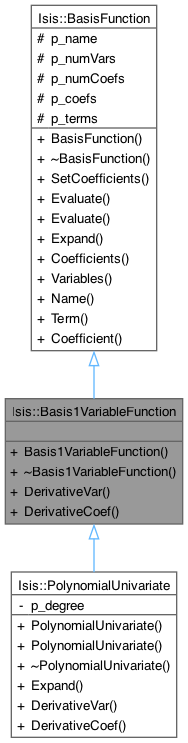
Inheritance diagram for Isis::Basis1VariableFunction:

Inheritance graph
[legend]
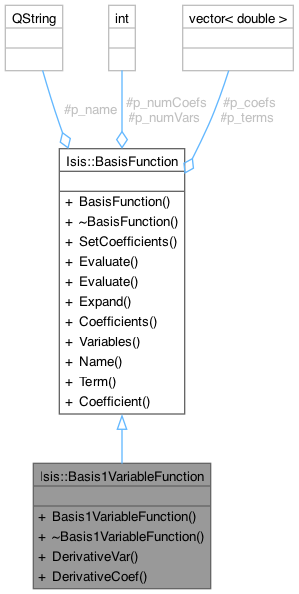
Collaboration diagram for Isis::Basis1VariableFunction:

Collaboration graph
[legend]
List of all members.

Detailed Description

Time based linear equation class.

This is a class for generating a general one-variable equation for the Isis least squares fitting algorithm (IsisLSQ). It allows the programmer to set up equations in the form of:

\[ x = C1*T1 + C2*T2 + ... + CN*TN; \]

where C1-CN are coefficients and T1-TN are terms with a single variable. For example,

\[ x = C1 + C2*t + C3*t**2 \]

Author:
2004-06-24 Jeff Anderson

For internal use only.

Todo:
Add coded example
History:
2005-03-16 Leah Dahmer modified file to support Doxygen documentation.
History:
2008-01-08 Tracie Sucharski, Derived from BasisFunction class for a single variable function. Added Derivative methods as pure virtuals. This class was developed as a convenience to simplify the Derivative methods and any other methods that might need to be developed in the future.

Definition at line 63 of file Basis1VariableFunction.h.

Public Member Functions

 Basis1VariableFunction (const std::string &name, int numCoefs)
 Creates a Basis Function with a single variable.
virtual ~Basis1VariableFunction ()
 Destroys the Basis1VariableFunction object.
virtual double DerivativeVar (const double value)=0
virtual double DerivativeCoef (const double value, const int coefIndex)=0
void SetCoefficients (const std::vector< double > &coefs)
 Set the coefficients for the equation.
double Evaluate (const std::vector< double > &vars)
 Compute the equation using the input variables.
virtual void Expand (const std::vector< double > &vars)
 This is the function you should replace depending on your needs.
int Coefficients () const
 Returns the number of coefficients for the equation.
int Variables () const
 Returns the number of variables in the equation.
std::string Name () const
 Returns the name of the equation.
double Term (int c) const
 Returns the cth term.
double Coefficient (int i) const
 Returns the ith coefficient.

Protected Attributes

std::string p_name
 The name of the equation. Call it by using Name().
int p_numVars
 The number of variables in the equation. Call it by using Variables().
int p_numCoefs
 The number of coefficients in the equation.
std::vector< double > p_coefs
 A vector of the coefficients in the equation.
std::vector< double > p_terms
 A vector of the terms in the equation.


Constructor & Destructor Documentation

Isis::Basis1VariableFunction::Basis1VariableFunction ( const std::string &  name,
int  numCoefs 
)

Creates a Basis Function with a single variable.

Parameters:
name Name of the Basis1VariableFunction. For example, "affine".
numCoefs Number of coefficients in the equation. For example:

\[ x = C1 + C2 * x + C3 * x**2 \]

has three coefficients: C1, C2 & C3.

Definition at line 41 of file Basis1VariableFunction.cpp.

virtual Isis::Basis1VariableFunction::~Basis1VariableFunction (  )  [inline, virtual]

Destroys the Basis1VariableFunction object.

Definition at line 67 of file Basis1VariableFunction.h.


Member Function Documentation

double Isis::BasisFunction::Coefficient ( int  i  )  const [inline, inherited]

Returns the ith coefficient.

Parameters:
i The index for the desired coefficient.
Returns:
The ith coefficient

Definition at line 109 of file BasisFunction.h.

Referenced by Isis::PolynomialUnivariate::DerivativeVar(), Isis::SurfaceModel::MinMax(), Isis::AutoReg::ModelSurface(), Isis::SpicePosition::ReloadCache(), Isis::SpicePosition::SetPolynomial(), Isis::OverlapNormalization::Solve(), Isis::Affine::Solve(), and Isis::BundleAdjust::Update().

int Isis::BasisFunction::Coefficients (  )  const [inline, inherited]

Returns the number of coefficients for the equation.

Returns:
The number of coefficients.

Definition at line 74 of file BasisFunction.h.

References Isis::BasisFunction::p_numCoefs.

Referenced by Isis::PolynomialUnivariate::DerivativeCoef(), Isis::PolynomialUnivariate::DerivativeVar(), Isis::SpicePosition::SetPolynomial(), Isis::OverlapNormalization::Solve(), Isis::LeastSquares::SolveQRD(), and Isis::LeastSquares::SolveSVD().

double Isis::BasisFunction::Evaluate ( const std::vector< double > &  vars  )  [inherited]

Compute the equation using the input variables.

Parameters:
vars A vector of double values to use for the equation. After setting the coefficients, this can be invoked many times to compute output values given input values.
Returns:
The output value.

Definition at line 73 of file BasisFunction.cpp.

References _FILEINFO_, Isis::BasisFunction::Expand(), Isis::iException::Message(), Isis::BasisFunction::p_coefs, Isis::BasisFunction::p_numCoefs, Isis::BasisFunction::p_numVars, and Isis::BasisFunction::p_terms.

Referenced by Isis::LeastSquares::Evaluate(), Isis::SpicePosition::ReloadCache(), Isis::LeastSquares::SolveQRD(), Isis::LeastSquares::SolveSparse(), and Isis::LeastSquares::SolveSVD().

void Isis::BasisFunction::Expand ( const std::vector< double > &  vars  )  [virtual, inherited]

This is the function you should replace depending on your needs.

It will expand the variables into the terms of the equation. For example,

\[ x = C1 + C2*y + C3*z + C4*y*z \]

must be expanded into the p_terms vector as (1.0, y, z, y*z). Note that the term expansion is not limited, you can use cos, sin, sqrt, abs, etc. This virtual method is automatically invoked by the Evaluate method. We provide a default expansion of p_terms = vars, just a linear combination of the variables.

Parameters:
vars A vector of double values to use for the expansion.

Reimplemented in Isis::Parabola, Isis::PolynomialBivariate, and Isis::PolynomialUnivariate.

Definition at line 108 of file BasisFunction.cpp.

References Isis::BasisFunction::p_terms.

Referenced by Isis::BasisFunction::Evaluate(), Isis::LeastSquares::FillSparseA(), Isis::LeastSquares::SolveQRD(), and Isis::LeastSquares::SolveSVD().

std::string Isis::BasisFunction::Name (  )  const [inline, inherited]

Returns the name of the equation.

Returns:
The name of the equation.

Definition at line 86 of file BasisFunction.h.

References Isis::BasisFunction::p_name.

Referenced by Isis::LeastSquares::AddKnown().

void Isis::BasisFunction::SetCoefficients ( const std::vector< double > &  coefs  )  [inherited]

Set the coefficients for the equation.

Parameters:
coefs A vector of coefficients for the equation.

Definition at line 55 of file BasisFunction.cpp.

References _FILEINFO_, Isis::iException::Message(), Isis::BasisFunction::p_coefs, and Isis::BasisFunction::p_numCoefs.

Referenced by Isis::SpicePosition::SetPolynomial(), Isis::LeastSquares::SolveQRD(), Isis::LeastSquares::SolveSparse(), and Isis::LeastSquares::SolveSVD().

double Isis::BasisFunction::Term ( int  c  )  const [inline, inherited]

Returns the cth term.

This is only valid after a Evalute/Expand has been invoked. It represents the expansion of the variables into the ith term. For example,

\[ x = C1 + C2*x + C3*y + C4*x*y \]

would return x*y for the 3rd term (zero-based)

Parameters:
c The index for the desired coefficient.
Returns:
The cth term.

Definition at line 101 of file BasisFunction.h.

References Isis::BasisFunction::p_terms.

Referenced by Isis::LeastSquares::FillSparseA(), Isis::LeastSquares::SolveQRD(), and Isis::LeastSquares::SolveSVD().

int Isis::BasisFunction::Variables (  )  const [inline, inherited]

Returns the number of variables in the equation.

Returns:
The number of variables.

Definition at line 80 of file BasisFunction.h.

References Isis::BasisFunction::p_numVars.

Referenced by Isis::LeastSquares::AddKnown(), and Isis::Parabola::Expand().


Member Data Documentation

std::vector<double> Isis::BasisFunction::p_coefs [protected, inherited]

A vector of the coefficients in the equation.

Call it by using Coefficient()

Definition at line 123 of file BasisFunction.h.

Referenced by Isis::BasisFunction::Evaluate(), and Isis::BasisFunction::SetCoefficients().

std::string Isis::BasisFunction::p_name [protected, inherited]

The name of the equation. Call it by using Name().

Definition at line 109 of file BasisFunction.h.

Referenced by Isis::BasisFunction::BasisFunction(), and Isis::BasisFunction::Name().

int Isis::BasisFunction::p_numCoefs [protected, inherited]

The number of coefficients in the equation.

Call it by using Coefficients()

Definition at line 119 of file BasisFunction.h.

Referenced by Isis::BasisFunction::BasisFunction(), Isis::BasisFunction::Coefficients(), Isis::BasisFunction::Evaluate(), and Isis::BasisFunction::SetCoefficients().

int Isis::BasisFunction::p_numVars [protected, inherited]

The number of variables in the equation. Call it by using Variables().

Definition at line 115 of file BasisFunction.h.

Referenced by Isis::BasisFunction::BasisFunction(), Isis::BasisFunction::Evaluate(), and Isis::BasisFunction::Variables().

std::vector<double> Isis::BasisFunction::p_terms [protected, inherited]

A vector of the terms in the equation.

Call it by using Term()

Definition at line 127 of file BasisFunction.h.

Referenced by Isis::BasisFunction::Evaluate(), Isis::PolynomialUnivariate::Expand(), Isis::PolynomialBivariate::Expand(), Isis::Parabola::Expand(), Isis::BasisFunction::Expand(), and Isis::BasisFunction::Term().


The documentation for this class was generated from the following files: