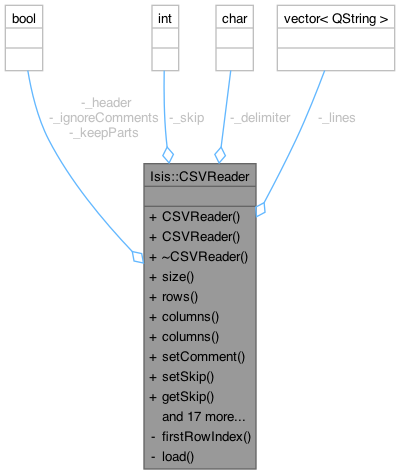
Reads strings and parses them into tokens separated by a delimiter character.
More...
|
| | CSVReader () |
| | Default constructor for CSV reader.
|
| |
| | CSVReader (const QString &csvfile, bool header=false, int skip=0, const char &delimiter=',', const bool keepEmptyParts=true, const bool ignoreComments=true) |
| | constructor
|
| |
| virtual | ~CSVReader () |
| | Destructor (benign)
|
| |
| int | size () const |
| | Reports the total number of lines read from the stream.
|
| |
| int | rows () const |
| | Reports the number of rows in the table.
|
| |
| int | columns () const |
| | Determine the number of columns in the input source.
|
| |
| int | columns (const CSVTable &table) const |
| | Determine the number of columns in a parser CSV Table.
|
| |
| void | setComment (const bool ignore=true) |
| | Allows the user to indicate comment disposition.
|
| |
| void | setSkip (int nskip) |
| | Indicate the number of lines at the top of the source to skip to data.
|
| |
| int | getSkip () const |
| | Reports the number of lines to skip.
|
| |
| bool | haveHeader () const |
| | Returns true if a header is present in the input source.
|
| |
| void | setHeader (const bool gotIt=true) |
| | Allows the user to indicate header disposition.
|
| |
| void | setDelimiter (const char &delimiter) |
| | Set the delimiter character that separate tokens in the strings.
|
| |
| char | getDelimiter () const |
| | Reports the character used to delimit tokens in strings.
|
| |
| void | setKeepEmptyParts () |
| | Indicate multiple occurances of delimiters are empty tokens.
|
| |
| void | setSkipEmptyParts () |
| | Indicate multiple occurances of delimiters are one token.
|
| |
| bool | keepEmptyParts () const |
| | Returns true when preserving succesive tokens, false when they are treated as one token.
|
| |
| void | read (const QString &fname) |
| | Reads the entire contents of a file for subsequent parsing.
|
| |
| CSVAxis | getHeader () const |
| | Retrieve the header from the input source if it exists.
|
| |
| CSVAxis | getRow (int index) const |
| | Parse and return the requested row by index.
|
| |
| CSVAxis | getColumn (int index) const |
| | Parse and return a column specified by index order.
|
| |
| CSVAxis | getColumn (const QString &hname) const |
| | Parse and return column specified by header name.
|
| |
| CSVTable | getTable () const |
| | Parse and return all rows and columns in a table array.
|
| |
| bool | isTableValid (const CSVTable &table) const |
| | Indicates if all rows have the same number of columns.
|
| |
| CSVColumnSummary | getColumnSummary (const CSVTable &table) const |
| | Computes a row summary of the number of distinct columns in table.
|
| |
| template<typename T> |
| TNT::Array1D< T > | convert (const CSVAxis &data) const |
| | Converts a row or column of data to the specified type.
|
| |
| void | clear () |
| | Discards all lines read from an input source.
|
| |
Reads strings and parses them into tokens separated by a delimiter character.
The class will read text strings from an input source stream or file where each line (string) contains a single character delimeter that separates them into tokens. The input stream is text in nature and each line is terminated with a newline as appropriate for the computer system.
This class provides methods that support skipping irrelevant lines and recognizing and utlizing a header line. Tokens within a given line are separated by a single character. Consecutive delimiter characters can be treated as empty tokens (columns) or translated as a single token. Typically, consecutive tokens as empty strings is used for comma separated values (CSV) whereas space delimited strings oftentimes require multiple spaces to be treated as a single separator. This class supports both cases.
Comments can exist in a CSV and are indicated with '#' as the first character in the line. Default behavior (as of 2010/04/08) is to ignore these lines as well as blank lines. Use the setComment() method to alter this behavior. Also note that the skip lines count does not include comments or blank lines.
Each text line in the input source is read and stored in an internal stack. Only when explicitly requested does parsing take place - no parsing is performed during the reading of the input source. This approach allows the users of this class to alter or otherwise adjust parsing conditions after the input source has been internalized. This makes this implementation efficient and flexible deligating more control to the users of this class.
The mechanism in which parsed data is stored and returned to the callers enviroment makes this class efficient. The returned rows, columns and tables use memory reference counting. This allows parsed data to be exported with virtually no cost to the calling environment in terms of efficiency. It does however, lend itself to utilization issues. Reference counting means that all instances of a parsed row, column or table refer to the same copy of the data and a change in one instance of those elements is reflected in all instances of that same row. Note that this concern rests entirely on how the caller's environment utilizes returned data as only the original lines read from the input source are maintained internal to objects.
The following example demonstrates how to use this class to read a comma delimited file that may have consecutive commas and should be treated as empty columns. Furthermore, there are 2 lines to skip and a header line as well:
cout << "\n\nProcessing comma table...\n";
QString csvfile("comma.csv");
CSVReader()
Default constructor for CSV reader.
Another way to ingest this file using methods instead of the constructor is as follows:
cout << "\n\nProcessing comma table using methods...\n";
QString csvfile("comma.csv");
void read(const QString &fname)
Reads the entire contents of a file for subsequent parsing.
void setSkip(int nskip)
Indicate the number of lines at the top of the source to skip to data.
void setKeepEmptyParts()
Indicate multiple occurances of delimiters are empty tokens.
void setDelimiter(const char &delimiter)
Set the delimiter character that separate tokens in the strings.
void setHeader(const bool gotIt=true)
Allows the user to indicate header disposition.
Using this method will always purge any previously read data from the CSVReader object.
- Author
- 2006-08-14 Kris Becker
- History
2008-06-18 Christopher Austin - Fixed documentation
2010-04-08 Kris Becker - Added discarding of comment and blank lines
Definition at line 239 of file CSVReader.h.
| Isis::CSVReader::CSVReader |
( |
| ) |
|
Default constructor for CSV reader.
The default constructor sets up to read a source that has not header and skips no lines. It also sets the delimiter to the comma, as implied by its name (CSV = comma separated value), and treats multiple successive occurances of the delimiting character as individual tokens (keeping empty parts).
This method can be used when deferring the reading of the input source. Other methods available in this class can be used to adjust the behavior of the parsing before [i]and[/i] after reading of the source as parsing is performed on demand. This means a single input source can be parsed repeatedly after adjusting parameters.
Definition at line 35 of file CSVReader.cpp.
References _delimiter, _header, _ignoreComments, _keepParts, _lines, and _skip.
Referenced by operator>>.
| Isis::CSVReader::CSVReader |
( |
const QString & | csvfile, |
|
|
bool | header = false, |
|
|
int | skip = 0, |
|
|
const char & | delimiter = ',', |
|
|
const bool | keepEmptyParts = true, |
|
|
const bool | ignoreComments = true ) |
constructor
Parameterized constructor for parsing an input file source.
- Parameters
-
| ignoreComments | boolean whether to ignore comments or not |
This constructor can be used when the input source is an identified file. Parameters are available for specifying the parsing behavior, but are not necessarily required here as defaults are provided. Other methods in this class can set parsing conditions after the input file has been read in.
If the file cannot be opened or an error is encountered during the reading of the file, an Isis exception is thrown.
All lines are read in from the file and stored for subsequent parsing. Therefore, parsing can be performed at any time upon returning from this constructor.
- Parameters
-
| csvfile | Name of file to open and read |
| header | Indicates if a header exists (true) in the file or not (false) |
| skip | Number of lines to skip to header, if it exists, or to the first data line |
| delimiter | Indicates the character to be used to delimit each token in the string/line |
| keepEmptyParts | Indicates successive delimiters are to be treated as empty tokens (true) or collapsed into one token (false) |
Definition at line 65 of file CSVReader.cpp.
References _delimiter, _header, _ignoreComments, _keepParts, _lines, _skip, keepEmptyParts(), and read().
| int Isis::CSVReader::columns |
( |
| ) |
const |
Determine the number of columns in the input source.
This method is applies the parsing conditions to all data lines to determine the number of columns. Note that it is assumed that all lines contain the same number of columns.
If the number of columns vary in any of the lines, the least number of columns found in all lines is returned due to the nature of how the columns are determined.
- See also
- isTableValid().
Note that this can be an expensive operation if the input source is large as all lines are parsed. This does not include the header.
- See also
- columns(const
CSVReader::CSVTable &table) for an alternative and more efficient method. That method takes a previously parsed table of all lines as an argument, which is precisely how this method determines the columns.
- Returns
- int Number of columns in table, smallest column count if some lines are different
- See also
- getColumnSummary()
Definition at line 97 of file CSVReader.cpp.
References columns(), getTable(), and rows().
Referenced by columns(), and Isis::SpectralDefinition1D::SpectralDefinition1D().
template<typename T>
| TNT::Array1D< T > Isis::CSVReader::convert |
( |
const CSVAxis & | data | ) |
const |
Converts a row or column of data to the specified type.
This method will convert a row or column of data to the specified type. Since this is a template method, it must be invoked explicity through template syntax. Here is an example to extract a column by a header name and convert it to a double precision array:
TNT::Array1D< double > CSVDblVector
Double array def.
Parser::TokenList CSVAxis
Row/Column token list.
At present, this class uses the Isis QString class as its token storage type (TokenType). All that is required is that it have a cast operator for a given type. If the Isis QString class has the operator, it can be invoked for that type. The precise statement used to convert the token to the explict type is:
In this example, s is the individual token and T is the type double as in the previous example.
Note that conversions of specific special pixel values is not inherently handled by this method. If you anticipate textual representations of special pixels, such as NULL, LIS etc..., this is left up to the caller to handle directly.
- Parameters
-
- Returns
- TNT::Array1D<T> Converted data array of specified type
Definition at line 532 of file CSVReader.h.
References Isis::toDouble().
Parse and return column specified by header name.
This method will parse and extract a column that corresponds to named column in the header. This method return a zero-length array if a header does not exist for this input source or the named column does not exist.
The header is parsed using the same rules as each row. It is the responsibility of the user of this class to specify the existance of a header. Once the header is parsed, a case-insensitive search of the names is performed until the requested column name is found. The index of this header name is then used to extract the column from each row.
It is assumed the column exists in each row. If it does not, a default constructed token is returned for non-existant columns in a row.
- Parameters
-
| hname | Name of the column as it exists in the header |
- Returns
- CSVReader::CSVAxis Column array parsed from each row
Definition at line 263 of file CSVReader.cpp.
References getColumn(), and getHeader().
Computes a row summary of the number of distinct columns in table.
A CSVColumnSummary is a CollectorMap where the key is the number of columns and the value is the number of rows that contain that number of columns. This is useful to determine the consistancy of a parser input source such that every row contains the same number of columns.
Once this summary is computed, there should exist one and only ome element in the summary where the key is the column count for each row and the value of that key is the number of rows that contain those columns.
This example shows how to determine this information:
cout << "Number of columns: " << csv.columns(table) << endl;
cout <<
"Number distinct columns: " << summary.
size() << endl;
for (
int ncols = 0 ; ncols < summary.
size() ; ncols++) {
cout <<
"--> " << summary.
getNth(ncols) <<
" rows have " << summary.
key(ncols) <<
" columns." << endl;
}
CollectorMap< int, int > CSVColumnSummary
Column summary for all rows.
TNT::Array1D< CSVAxis > CSVTable
Table of all rows/columns.
const K & key(int nth) const
Returns the nth key in the collection.
int size() const
Returns the size of the collection.
T & getNth(int nth)
Returns the nth value in the collection.
- Parameters
-
| table | Input table as returned by the getTable method |
- Returns
- CSVReader::CSVColumnSummary A CollectorMap that idicates the number of rows with distinct numbers of columns
- See also
- getTable()
-
isTableValid()
Definition at line 344 of file CSVReader.cpp.
References Isis::CollectorMap< K, T, ComparePolicy, RemovalPolicy, CopyPolicy >::add(), Isis::CollectorMap< K, T, ComparePolicy, RemovalPolicy, CopyPolicy >::exists(), and Isis::CollectorMap< K, T, ComparePolicy, RemovalPolicy, CopyPolicy >::get().
Referenced by columns(), and isTableValid().
Parse and return all rows and columns in a table array.
This method returns a 2-D table of all rows and columns after parsing rules are applied. Each column or token in each row is returned as a CSVParser::TokenType. Subsequent conversion can be performed if the type sufficiently supports it or the user can provide its own conversion techniques.
The validity of the table with regards to column integrity (same number of columns in each row) can be checked with the isTableValid method. A summary of the number of rows containing differing numbers of columns is provided by the getColumnSummary method.
The returned table does not include the header row or any skipped rows. An empty table, zero-length array is returned if no rows are present.
The table itself is a 1-dimenional array that contains a row at each element. This conceptually is a 2-dimensional table. Each element in the row (first) dimension of the table is a CSVAxis array containing parsed columns or tokens. Note that the number of columns may vary from row to row.
- Returns
- CSVReader::CSVTable 2-D table of parsed columns in each row
Definition at line 302 of file CSVReader.cpp.
References _delimiter, _keepParts, _lines, firstRowIndex(), Isis::CSVParser< TokenStore >::parse(), Isis::CSVParser< TokenStore >::result(), and rows().
Referenced by columns().
| std::istream & Isis::CSVReader::load |
( |
std::istream & | ifile | ) |
|
|
private |
Reads all lines from the input stream until an EOF is encoutered.
This method is the used to read from an input stream all lines of text until an end-of-file (EOF) is encountered. It is used to perform read operations for all sources of input, files and direct streams as supplied by the users of this class.
All lines are assumed to end with a newline sequence pertinent to the systems this software is compiled on. All lines are stored as they are read in unless they are empty lines. The default behavior is to treat all lines that begin with a '#' as a comment. These lines are ignored by default and excluded as they are read. (Comment and blank line feature was added 2010/04/08.)
As lines are read in from the input stream, they are pushed onto the internal stack in the order they are read. The calling environment is responsible for the state of the stack as to whether it is cleared or appended to an existing state.
- Parameters
-
| ifile | Input source stream of lines of text |
- Returns
- std::istream& Returns the state of the input stream at the end of read operations.
Definition at line 402 of file CSVReader.cpp.
References _ignoreComments, _lines, and Isis::IException::User.
Referenced by operator>>, and read().
| void Isis::CSVReader::read |
( |
const QString & | csvfile | ) |
|
Reads the entire contents of a file for subsequent parsing.
This method opens the specified file and reads every line storing them in this object. It is assumed this file is a text file. Other methods in this class can be utilized to set parsing conditions before [i]or[/i] after the file has been read.
Note that parsing the file is deferred until explicity invoked through other methods in this class. Users of this class can extract individual rows, columns or the complete table.
This object is reentrant. Additional files can be read in. Any existing data from previous input sources is discarded upon subsequent reads.
- Parameters
-
| csvfile | Name of file to read |
Definition at line 140 of file CSVReader.cpp.
References _lines, load(), and Isis::IException::User.
Referenced by CSVReader().